The Switchovers
Switzerland Closes the Loop
Seven years after Norway, the Swiss confederation completed its DAB+ migration — but it did so on its own terms, with FM surviving longer and in more places than Oslo ever permitted.
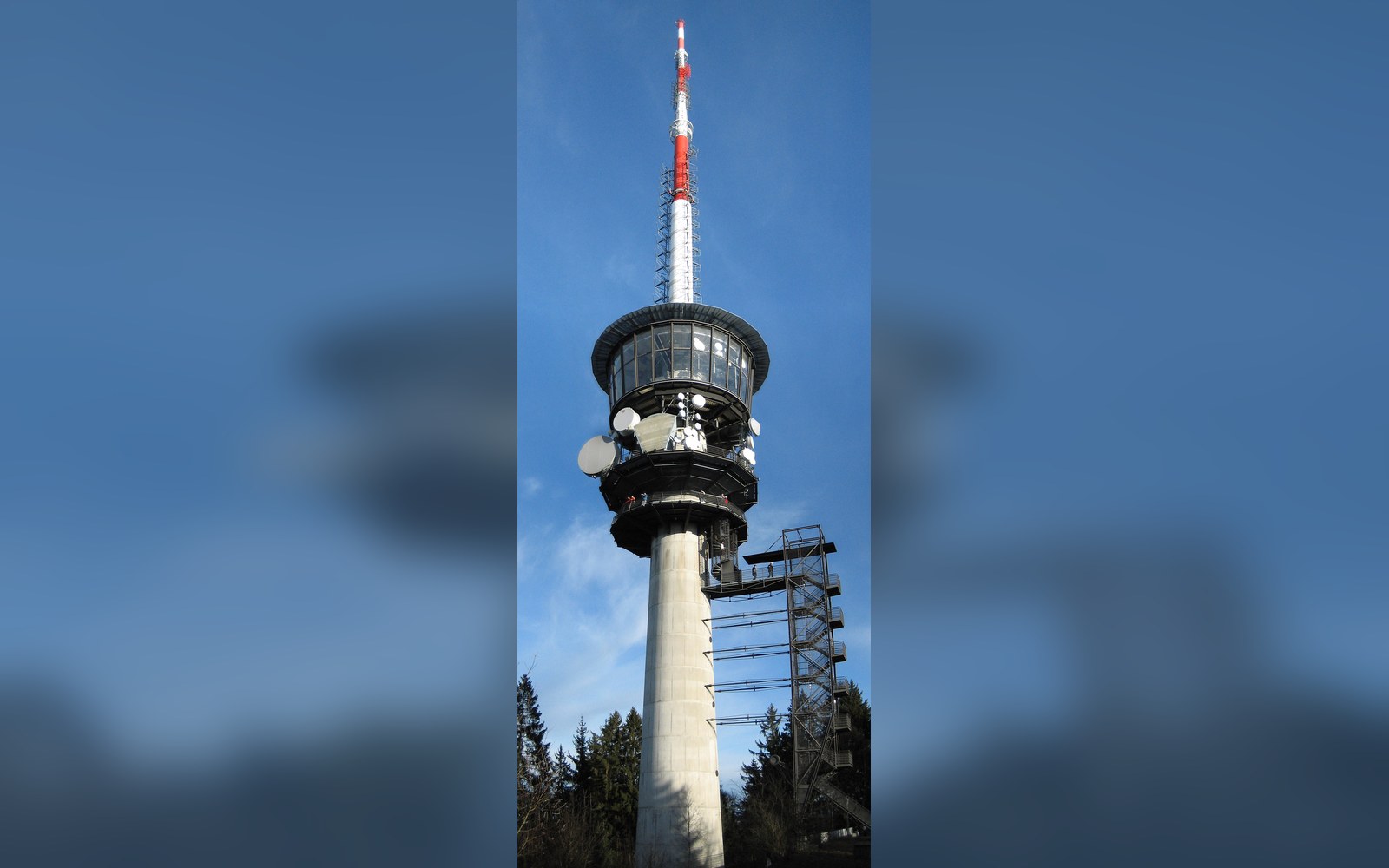
The Bantiger broadcasting tower near Bern, one of the Swiss transmitter sites involved in the FM and DAB+ transition.
Photo: FernsehturmBantiger · Wikimedia CommonsThe Decision and the Timeline
Switzerland's federal communications regulator, OFCOM (the Office fédéral de la communication, known in German as BAKOM), spent the better part of a decade building the commercial and technical case for FM switch-off. The final shutdown of national FM broadcasting was completed in 2024, ending a migration that had begun in earnest when Swiss national broadcasters started investing heavily in DAB+ infrastructure in the early 2010s. The Swiss national public broadcaster SRG SSR — the equivalent, in structural terms, of the BBC or NRK — led the transition, gradually shifting its audience toward the digital multiplex network that by the mid-2020s reached the overwhelming majority of the country's population.
The regulator's approach was methodical rather than dramatic. OFCOM did not set a hard switch-off date a decade in advance and defend it against commercial pressure. Instead, it tied the migration to a measurable threshold: when digital listening share crossed a defined level and DAB+ coverage reached a workable ceiling, the national FM licences would be permitted to lapse. DAB+ receiver penetration in Swiss households climbed steadily through the late 2010s, and by the time the 2024 shutdown arrived, the industry had had several years of effective notice.

Master control is where a switch-off is executed: programme feeds, transmitter status and helpline traffic are read from one desk.
Photo: Caleb Oquendo / PexelsWhat Switzerland Did Differently
Norway's FM shutdown, completed region by region between January and December 2017, was the world's first national analogue radio switch-off and was executed at speed. Norway's approach was a government mandate coordinated with NRK and the commercial sector simultaneously; regional populations lost FM with relatively short transition windows, and the process generated real public friction, particularly in rural areas where in-car receivers had not yet been replaced.
Switzerland chose a slower, more federated path, and the Swiss political structure made that nearly inevitable. The confederation's linguistic and cantonal complexity — four national languages, strong regional broadcaster identities — meant that a top-down, simultaneous shutdown was neither politically viable nor technically straightforward. Regional and local FM licences were not terminated on the same schedule as national ones. A category of smaller, community-oriented and regionally licensed FM stations retained their frequencies after 2024, a distinction that Norway did not make in the same way. In Switzerland, the completion of the migration is therefore better described as the end of national FM rather than the end of FM as a whole.
That distinction matters commercially. Switzerland's regional commercial sector is less consolidated than the UK's, where Bauer and Global between them carry the majority of commercial listening, and the economics of forcing smaller operators onto digital-only transmission sooner than the market could sustain would have produced service losses rather than upgrades. OFCOM calibrated the cut-off accordingly.
Seven Years and a Different Country
The comparison with Norway is instructive precisely because both countries run prosperous, high-connectivity economies with strong public broadcasting traditions, and both eventually arrived at the same destination. The gap between 2017 and 2024 reflects the difference between a unitary state with a centralised broadcasting infrastructure and a federal one with distributed obligations and a multilingual public to serve.
Switzerland also benefited from watching Norway. The political difficulty Norway encountered — receivers in older cars, elderly listeners, emergency broadcasting contingencies — gave Swiss planners a checklist of problems to address before the shutdown rather than during it. Edison Research data tracking digital audio adoption patterns broadly confirms that later adopters of DAB+ migration tend to have higher receiver penetration at the moment of switch-off than first movers do, simply because the market has had longer to adjust.
What Switzerland demonstrates is that the completion of a DAB+ migration is as much a regulatory design problem as a technical one. Norway proved the concept was executable. Switzerland proved it could be done without generating Norway's degree of listener protest — at the cost of seven additional years and a more complicated residual FM landscape.
More in The Switchovers