Listening
Two Decades Without Ads: The SomaFM and Radio Paradise Model
Two of internet radio's oldest survivors have never run a commercial. Their listeners pay the bills — including a royalty obligation that has killed younger services.
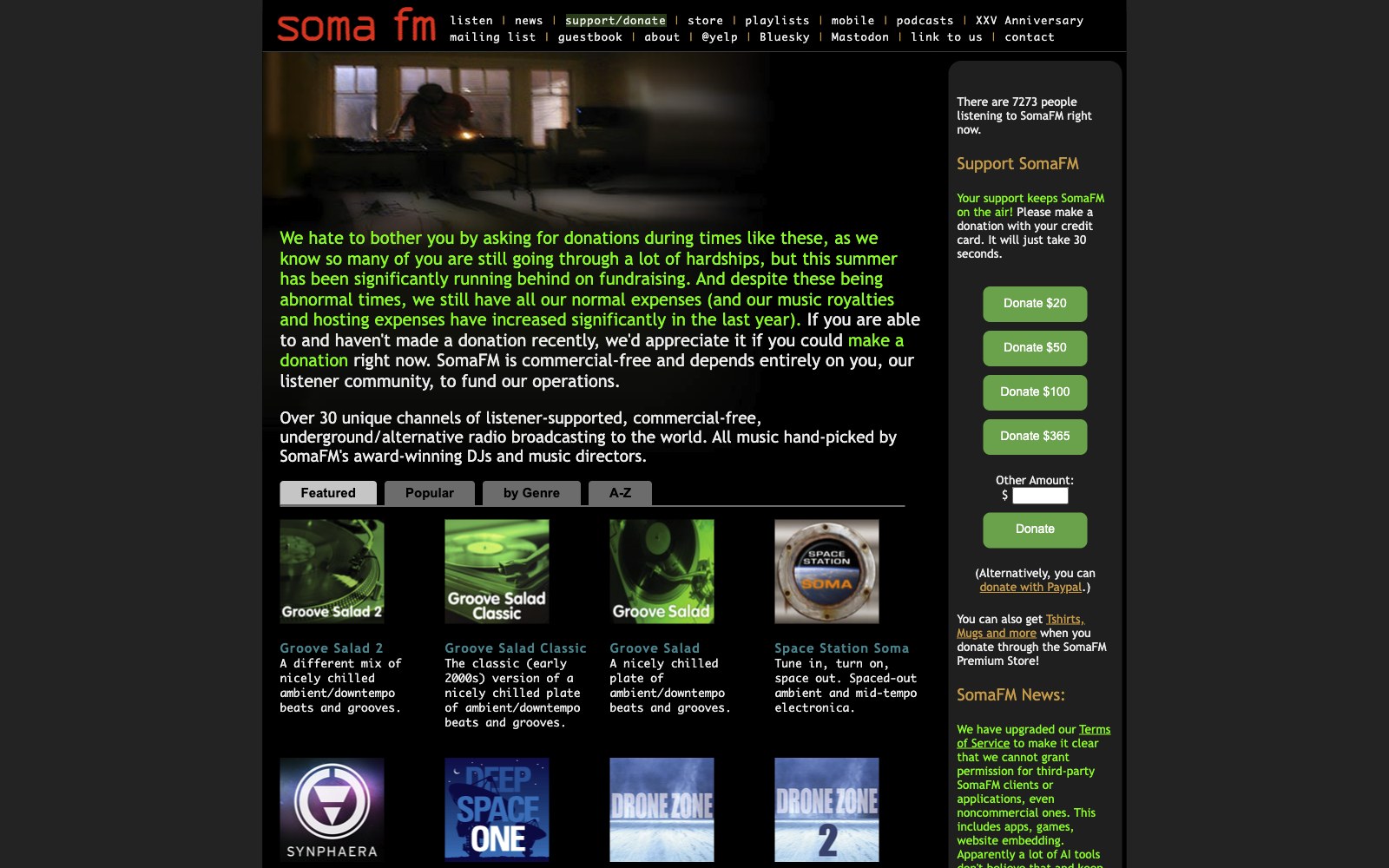
The angle is sustainability: the model has run longer than most commercial webcasters who launched the same year.
Photo: somafm.comBorn the Same Year, Still Running
SomaFM launched in San Francisco in 2000. Radio Paradise launched the same year in Paradise, California. Both arrived at the moment when internet radio looked like a mass-media insurgency, when dozens of commercial webcasters were burning venture capital on streaming infrastructure and rights negotiations. Nearly all of those better-funded competitors are gone. SomaFM and Radio Paradise are still broadcasting.
The model both chose — listener-funded, advertising-free — looked marginal at the time. It has proven more durable than the advertising-supported alternative, and the reason is structural. A webcaster whose revenue depends on ad inventory tied to listener volume is exposed to two simultaneous pressures: royalties that scale with every stream played, and advertising revenue that fluctuates with markets. Remove the advertising, replace it with voluntary listener donations, and the cost base and the income base track each other more naturally. When listening grows, donations tend to grow with it.
The existing car fleet is the constraint in every migration. An adapter retransmits a digital multiplex on an unused FM frequency inside the cabin.
Photo: Nikita Krasnov / PexelsThe Royalty Burden That Shapes Everything
Neither service escapes the Copyright Royalty Board rate schedule. As non-interactive digital audio services, both SomaFM and Radio Paradise pay statutory royalties to SoundExchange on every sound recording they stream — rates set through the CRB's multi-year proceedings and applied per-performance, meaning per-song per-listener. The rate has increased across successive CRB determination cycles. For small webcasters operating on thin margins, the per-performance structure is not neutral: it penalises services that attract large audiences without necessarily scaling revenue at the same rate.
SomaFM came close to shutting down in 2002, when the Copyright Office issued a retroactive royalty determination that would have required back payments many webcasters could not meet. The service appealed publicly to its listeners and received enough donations to survive. That crisis established the template: the audience, not advertisers, would be the financial backstop. Radio Paradise has operated on the same premise, supplemented in recent years by a tiered app-based contribution model that offers listeners lossless audio streams as an incentive for higher-level support.
Both services are required by statute to report detailed performance data to SoundExchange, covering each track played, the number of listeners, and the timestamp — the same reporting burden borne by commercial webcasters. The administrative cost of compliance is not trivial for organisations with small staff headcounts.
Why the Model Has Held
The sustainability argument is not romantic. It rests on a specific cost structure. SomaFM runs multiple curated channels from San Francisco with a small team; Radio Paradise is effectively a family operation based in a small Northern California town. Neither carries the debt load that weighed on large commercial broadcasters such as iHeartMedia or the acquisition costs that burdened commercial competitors. Overheads are low enough that listener contributions — typically a few dollars per month from a fraction of the active audience — can cover royalties and infrastructure.
The listener relationship is also different from the advertiser relationship. Donors have a stated preference for the service and a reason to sustain it that does not depend on quarterly earnings cycles. Edison Research data has consistently shown that internet radio listeners skew toward habitual, long-session use — exactly the audience type most likely to convert to financial supporters when asked directly.
Both services have now operated across five CRB rate-setting cycles, multiple platform shifts — from Icecast streams to HLS delivery to smart-speaker integrations — and two decades of consolidation that erased most of their original peers. That record does not prove the model scales beyond small, curator-led services. It does prove the model survives.
More in Listening