The Signal
DAB, DAB+, and What the Codec Upgrade Actually Changed
More services, smaller signals — but the receivers you already owned could not follow.
The angle is the upgrade's cost: DAB+ is more efficient but early DAB receivers cannot decode it, which is why some markets ran both in parallel.
Photo: Karolina Grabowska www.kaboompics.com / PexelsThe Standard and Its Successor
Digital Audio Broadcasting launched in the early 1990s under the ETSI EN 300 401 specification, built around the MPEG-1 Audio Layer II codec — MP2, the same compression algorithm used in early CD-ROM video and broadcast contribution. It worked. By the time Norway's first DAB multiplex went to air and the BBC launched its national DAB services in the United Kingdom, the standard was technically solid. MP2 was well understood, latency was low, and the multiplex architecture — bundling multiple stations onto a single transmitted channel — suited the VHF Band III and L-band frequencies being allocated for digital radio.
What MP2 was not was efficient. To deliver audio that most listeners accepted as adequate, a station needed somewhere between 128 and 192 kilobits per second per stereo stream. A multiplex carries a finite total bitrate; more bits per station means fewer stations per multiplex. By the mid-2000s, broadcasters and regulators were already watching the arithmetic with concern. The original DAB standard was consuming capacity that could carry additional services, and some operators were compressing so aggressively — dropping to 96 kbps or lower — that audio quality fell noticeably.
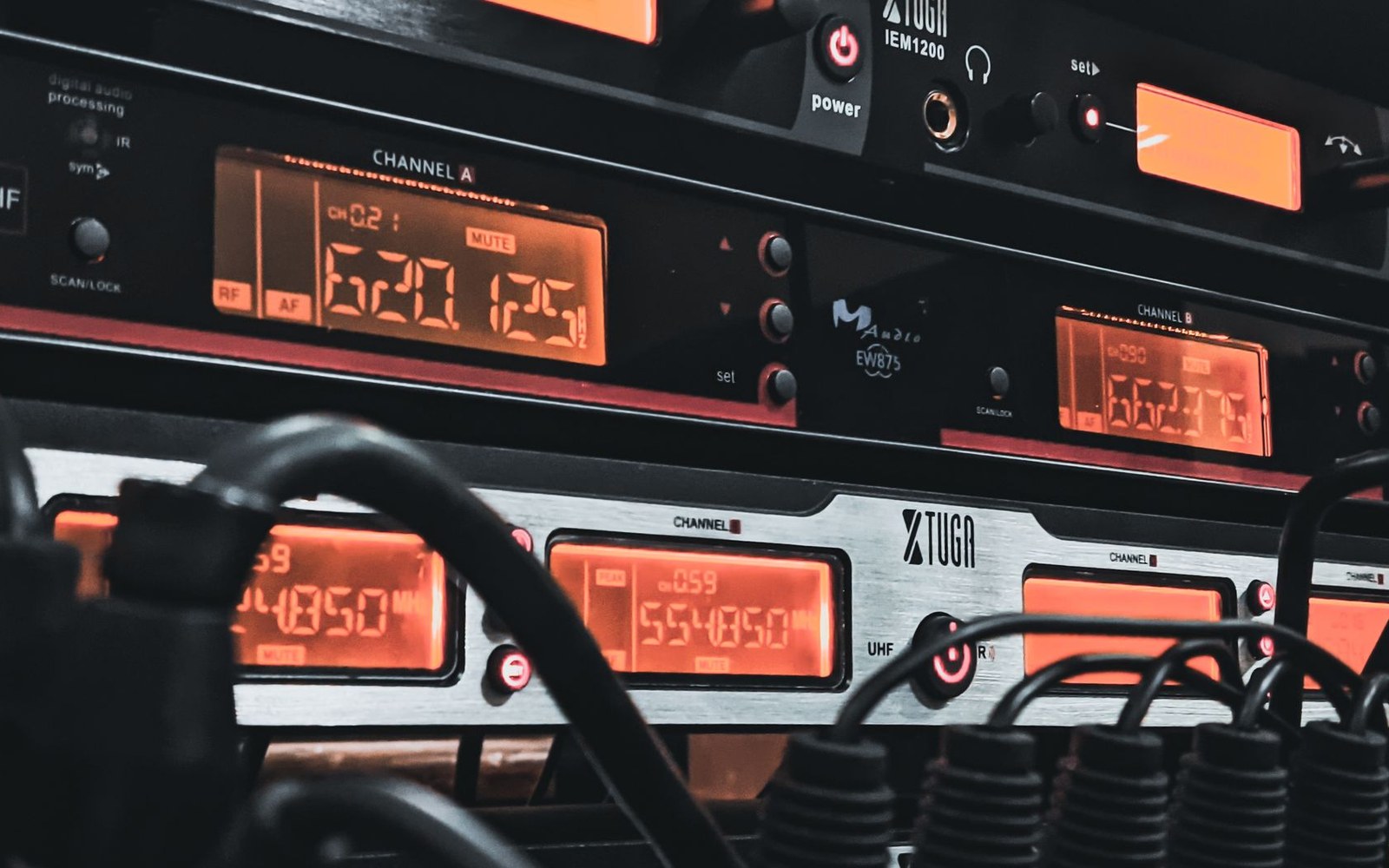
Processing sits between playout and transmission, and it is where loudness policy stops being a document and becomes a setting.
Photo: Busalpa Ernest / PexelsWhat HE-AAC v2 Changed
DAB+, formalised under ETSI TS 102 563, replaced MP2 with High-Efficiency Advanced Audio Coding version 2 (HE-AAC v2), a codec that combines AAC-LC compression with Spectral Band Replication and Parametric Stereo. The result is roughly two to three times the coding efficiency of MP2 at the same perceived quality level. A station that required 128 kbps on DAB can deliver comparable or better audio at 48–64 kbps on DAB+. On a typical multiplex, that difference translates directly into headroom for additional services — more stations, data services, or emergency alert channels — without expanding the radio-frequency footprint at all.
The gain in capacity is not theoretical. Switzerland's migration, completed in 2024, moved its national and regional services entirely to DAB+ and populated multiplexes with services that would have been impossible to fit under the original standard. Germany mandated DAB+ receivers in all new cars under the Telekommunikationsgesetz, and the services filling German multiplexes are almost uniformly DAB+ encoded. The efficiency argument, in retrospect, was decisive.
The Compatibility Break
The upgrade's cost was a hard receiver incompatibility. A device built to decode MP2 under the original DAB specification carries no HE-AAC v2 decoder. It can receive the DAB+ signal, synchronise to the multiplex, and identify the service — but it cannot decode the audio. The listener hears silence, or nothing at all. There is no graceful degradation, no reduced-quality fallback.
This mattered most in markets where DAB had been commercially active long enough to place millions of receivers in homes and dashboards. The United Kingdom, which began DAB services in 1995 and grew a substantial installed base through the 2000s, faced pressure not to strand those devices. For several years, UK multiplexes carried a mix of DAB and DAB+ services, with older stations remaining on MP2 and newer or smaller services launching in DAB+. The UK DAB rollout created a two-tier multiplex landscape that complicated both programming decisions and receiver marketing.
Norway, which executed its FM switch-off region by region in 2017, had timed its analogue closure to coincide with a period when DAB+ receivers were becoming the market norm, reducing the compatibility exposure. Countries with shorter DAB histories — or those arriving at digital radio later — could adopt DAB+ from the outset and avoid the parallel-running cost entirely.
Where the Parallel Running Ends
The ETSI standards themselves do not mandate a retirement date for original DAB encoding. That decision belongs to multiplex operators and national regulators. In practice, the economics run in one direction: as HE-AAC v2 receivers reach near-saturation in a given market, the cost of maintaining MP2 streams — in capacity terms — becomes harder to justify. The codec transition, in broadcast terms, is never a single event. It is a slow rebalancing of a multiplex, service by service, until the older encoding format becomes too expensive to keep.
More in The Signal