The Signal
From Microphone to Mast: The Broadcast Chain in Its Current Form
The angle is the chain's length: there are more conversion steps between voice and listener now than in the analogue era.
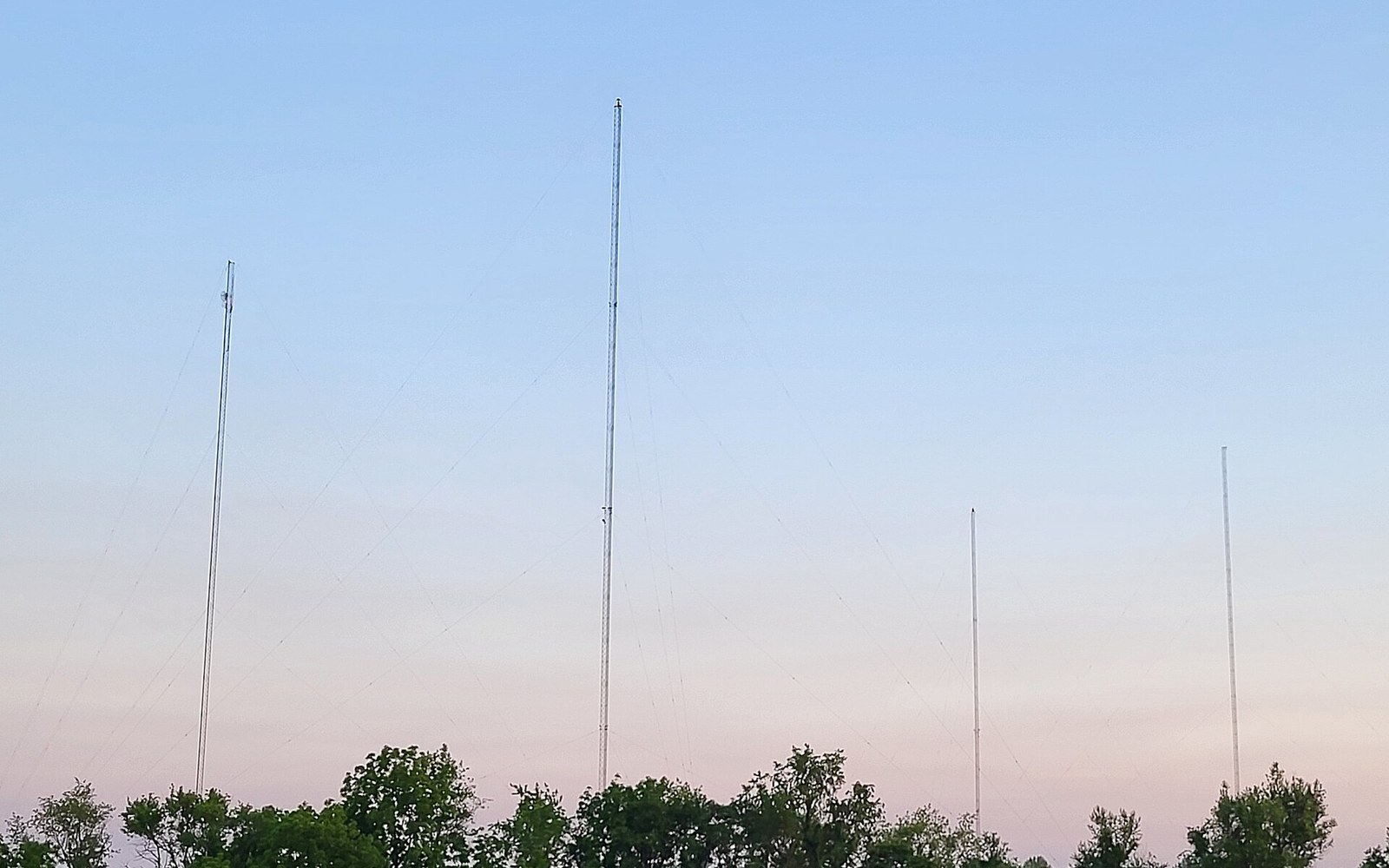
Photo: AM radio transmission towers for WWRC and WSBN ESPN sports radio (3 June 2025) · Wikimedia CommonsThe distance between voice and listener has never involved more conversion steps
Every Hop Has a Cost
A presenter speaks into a microphone. By the time that voice reaches a listener's speaker, it has passed through somewhere between eight and twelve discrete conversion stages — each one introducing processing, repackaging, or re-encoding. In the analogue era, the number was closer to three.

Every channel strip is a gain stage. What leaves the desk is already the product of decisions taken before any transmission standard applies.
Photo: Scott Platt / PexelsThe first conversion happens at the microphone capsule itself: acoustic energy becomes an electrical analogue signal. That signal enters a mixing console, where it is almost certainly converted to digital at the gain stage — most broadcast consoles since the early 2000s operate on AES3, the professional standard for two-channel digital audio, running at 48 kHz and 24-bit depth. Routing, processing, and mix happens entirely within the digital domain.
From the console, the signal passes through an audio processor — typically a unit applying loudness management, limiting, and spectral shaping to meet platform targets. For DAB+ transmission, the relevant target is EBU R 128; for FM, the processor also handles pre-emphasis and peak control. This is a second encode-and-shape step that did not exist as a discrete processing layer in the earliest broadcast chains.
The signal then travels from the studio to the transmitter via a studio-to-transmitter link (STL). Older STLs used dedicated microwave hops; modern installations increasingly route over managed IP networks using encapsulation protocols such as SMPTE 2022 or SRT (Secure Reliable Transport). Each protocol introduces a packetisation and de-packetisation step — another conversion — plus buffer latency to protect against packet loss.
At the transmitter site, the signal is decoded from its transport wrapper, processed again for RF headroom, and handed to the exciter. For FM, this is a relatively direct path to the modulator. For DAB+, the audio is encoded in HE-AAC v2 — a lossy codec step — then multiplexed with other stations' streams, error-correction data, and programme-associated data into a single ensemble before modulation. The multiplex is itself a complete repackaging of the source audio.
The modulated RF signal travels up the feeder to the antenna and radiates. A DAB+ receiver catches it, demodulates the ensemble, decodes the specific station's HE-AAC stream, converts to analogue, and drives the speaker. That final decode-and-convert is the listener's side of the chain.
The analogue FM path — microphone, console, processor, STL, exciter, antenna, receiver — was always at least five steps; the DAB+ path adds codec encoding, multiplexing, error-correction framing, and a corresponding decode ladder at the other end. Each conversion is engineered to be transparent, and largely succeeds. But transparency is an achievement, not a given, and the chain's length is the reason broadcast engineers still treat signal path integrity as a discipline in its own right.
More in The Signal