The Money
How the Copyright Royalty Board Sets the Rate Every Five Years
The rate webcasters pay for sound recordings is not negotiated across a table. It is litigated before a federal panel — and the outcome shapes the economics of internet radio for years at a time.
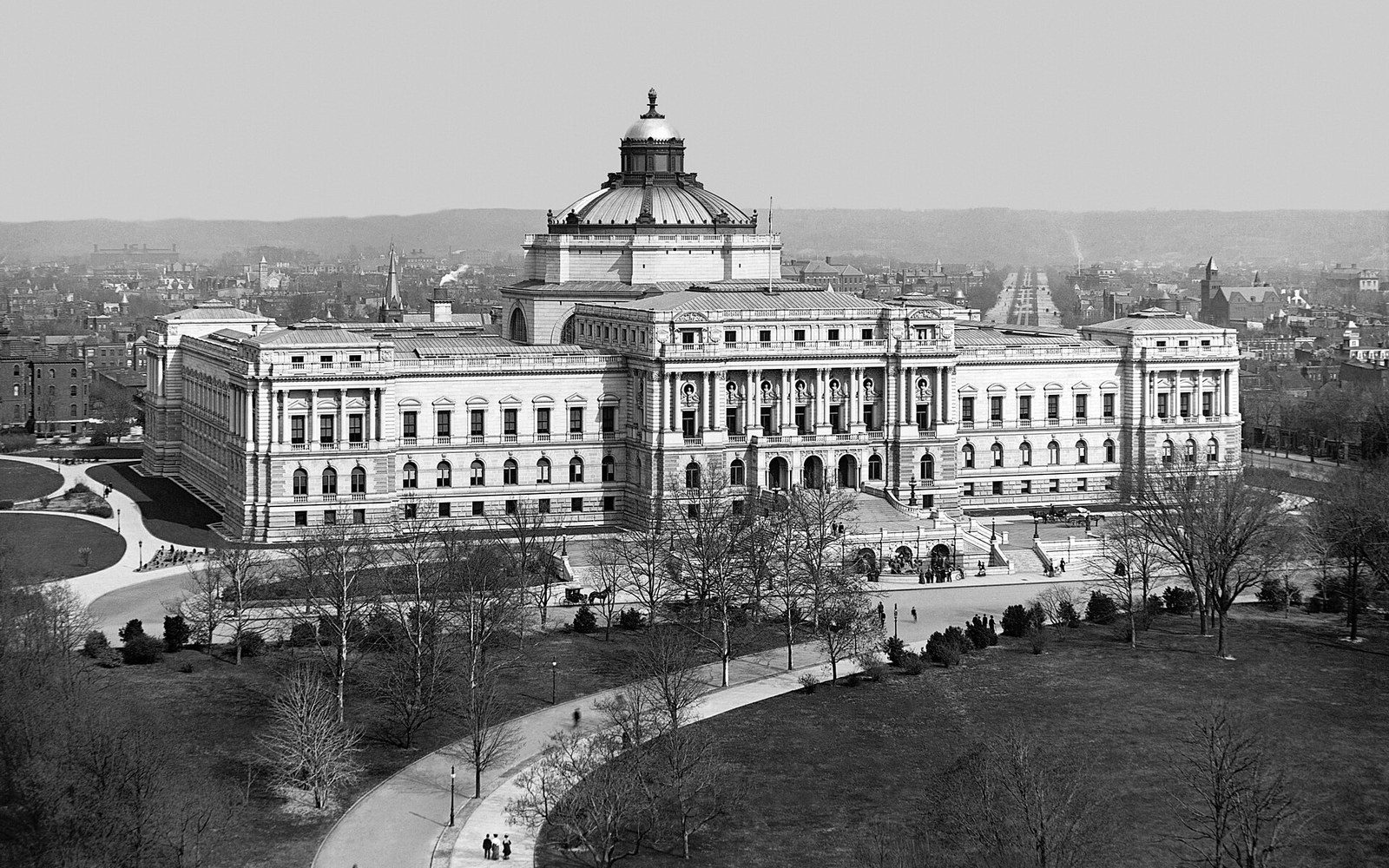
The angle is process: the rate is not negotiated, it is litigated before a panel.
Photo: Library of Congress, Washington, D.C. - c. 1902 · Wikimedia CommonsA Court in Everything but Name
The Copyright Royalty Board is a three-judge body housed within the Library of Congress. Its mandate, established under the Copyright Royalty and Distribution Reform Act of 2004, is to determine the royalty rates that digital music services must pay for the statutory licence covering sound recordings. Webcasters — internet radio stations, simulcasters, and non-interactive streaming services — cannot opt out of the process. The CRB's determination is binding.
Proceedings run on a five-year cycle. Each round is named sequentially: Web I, Web II, Web III, Web IV, Web V. The structure is adversarial. SoundExchange, the statutory collective that represents recording artists and labels, argues for higher rates. Webcasters — ranging from large commercial operators to listener-funded stations such as Radio Paradise and SomaFM — argue for rates they can survive. The National Association of Broadcasters participates on behalf of AM and FM simulcasters, who face the same per-stream obligations as pure internet stations despite their terrestrial footprint.

A statement is the only place a per-stream rate becomes a number. Line items resolve to performances, not to hours of listening.
Photo: Kindel Media / PexelsEvidence sessions resemble trial proceedings: written testimony, economic expert witnesses, cross-examination. SoundExchange typically submits benchmark data drawn from on-demand licensing deals — Spotify, Apple Music — arguing those rates should anchor the statutory minimum. Webcasters counter that non-interactive services generate lower commercial value for rights holders, that listener churn and ad revenue differ materially from on-demand platforms, and that rates set too high simply kill off smaller operators.
What the Numbers Have Done
The per-performance rate — charged per song per listener per stream — has risen steadily across determination periods. Under Web IV, which governed 2016 through 2020, the CRB set rates that escalated annually, reaching $0.0018 per performance for commercial webcasters by the final year. The Web V proceeding, covering 2021 through 2025, produced further increases after a contested evidentiary record. The judges accepted much of SoundExchange's benchmarking argument, concluding that the willing-buyer / willing-seller standard Congress prescribed supported a higher floor.
Rate chronology
The Money
- Web IV (2016–2020)
- commercial webcaster rate reached $0.0018 per performance by 2020
- Web V (2021–2025)
- further escalation; CRB accepted SoundExchange benchmarking from on-demand market
- Web VI (2026–)
- proceeding preparation underway ahead of the determination window
How the process works
The Money
- CRB: three-judge panel inside the Library of Congress; binding determinations
- Standard applied: willing-buyer / willing-seller (not cost-plus or rate-of-return)
- Parties: SoundExchange (labels/artists) vs. webcasters including NAB simulcasters
- Appeal route: US Court of Appeals for the DC Circuit
- Non-commercial and small-webcaster tiers exist but carry separate rate structures
For large operators — iHeartMedia, which runs a significant simulcast and digital footprint, or Audacy before its Chapter 11 filing — the per-stream accumulation across millions of daily listeners is the single largest operating cost line in digital audio. For smaller webcasters, the arithmetic is existential: a station with modest listenership can owe more in royalties than it earns in a year.
The CRB does publish a small-webcaster settlement provision, and certain non-commercial educational and public-radio stations operate under different rate tiers. But the headline commercial rate commands the most attention, and it is the commercial rate that SoundExchange and the major labels push hardest in each proceeding.
Why the Process Matters Beyond the Numbers
The five-year cycle creates a structural uncertainty that distorts planning. Operators cannot commit to long-term infrastructure investment when the cost basis may shift materially before the next determination lands. Broadcasters have repeatedly lobbied Congress for a move to direct licensing or a negotiated settlement framework, without success. The statutory licence remains the governing mechanism because it provides a legal path to broadcast any sound recording without individual label consent — a right the industry is unwilling to surrender even at a punishing rate.
The CRB's determinations are subject to appeal to the US Court of Appeals for the DC Circuit, and several rounds have produced post-determination litigation. The judges are required to apply the willing-buyer / willing-seller standard rather than a rate-of-return or cost-plus approach, a constraint that consistently advantages rights holders in a market where on-demand services set the visible price ceiling.
The next proceeding — Web VI, covering 2026 onwards — will begin formal rate-setting activity in the period immediately preceding that window, with SoundExchange and webcasters already preparing the economic record that the panel will eventually weigh.
More in The Money